



INTRODUCTION to ZERO BASED BUDGETING:
Once I was laying on my bed in my PJs mindlessly scrolling my Instagram feed. Thinking about the wonders of technology, shopping has become so hassle-free now. I don’t need to get up, put on my nice clothes and then rush to a shopping mall to get a top. What a relief!
After some time when I checked my bank statement, the relief was gone. I had spent more than my financial capability. A few moments of dopamine rush cost me a whole month of financial distress and agony. We have all faced this issue at some point in our lives. Instead of living with a financial crisis, I decided to adopt a new financial approach called Zero Based Budgeting.
Let’s talk about what is zero based budgeting and how it can make your financial life easy and smooth.
Zero based budgeting, a strategic budgeting technique introduced by Peter Pyhrr in 1973 stands out as a considerable option.
What is Zero Based Budgeting?
Zero based budgeting technique is a financial planning method where all the resources are generated from zero or scratch for each new period. By following this approach a person makes himself accountable to the every penny, every dollar he spends. It makes every spending justified and planned. ZBB needs a thorough review of every single spending during the financial period. The main goal of ZBB plan is to align spending costs with financial strategies and enhance sense of accountability in personal and professional finances. It ensures financial discipline and transparency in one’s life.
ZBB enables a person to scrutinize every expense, build resource efficiency, implement strict financial controls to maximize savings and minimize the chances of financial crisis.
How Zero Based Budgeting Works?
Remember back in high school when our economics teacher used to give us a class assignment about spending 10$ in the market, and we’ve allocated every penny wisely to each of your imaginary shopping items to balance the things out. That’s exactly zero-based budgeting is in practical life.
Example of zero based budgeting:
For instance, I have monthly income of $1000 after paying taxes. I spend money mindlessly on fast food. Some months i spend $60 and other months $160. At the end of the month, I am short on savings.
With zero based budgeting, I start from scratch on 1st and decide:
“This month I will spend excatly $60 on fast food, no more, no less.”
This way the mindless spending would be curbed.
Zero Based Budget Planning vs Traditional Budgeting:
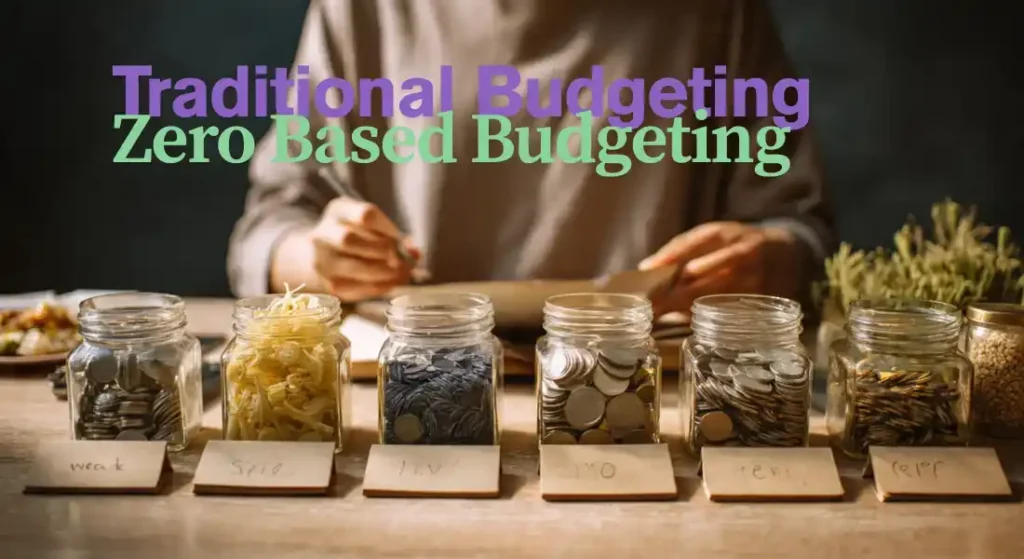
Traditional Budgeting is an idea contradictory to Zero Based Budget planning. The primary difference between zero budgeting and traditional budgeting is considered in their baseline finances.
In Zero Based budgeting management, the financial baseline is set from scratch from a new financial period or year. Traditional budget planning goes along with former period actual budget as a financial baseline.
| Zero-Based Budget Plan | Traditional Budgeting |
| Financial baseline is set from Scratch. | Uses the former period actual budget as a baseline. |
| Innovative Financial approach. | Old School financial approach. |
| Need capital to implement. | Can use previous funds. |
| Complex execution | Simple execution |
Advantages of ZERO BASED BUDGETING Management:
- Zero-based budgeting management makes spending more strategic and mindful. It gives a person financial control and focus.
- It makes one more accountable for every penny, making sure only value driven spending would be done.
- ZBB optimizes the process of evaluation, eliminating the weightage of unnecessary costs and shortfalls of previous years.
- It lowers wasteful spending and ensures that every penny goes in the right direction.
- By adopting the ZBB approach, one starts to focus on resource production and allocation more thoughtfully.
- It enhances efficiency and leads to leaner, strategically driven and agile financial management plan.
Cost Control:
As per report “How absolute zero (-based
budgeting) can heat up growth” published in January 2018 by Mckinsey claimed that , “Companies that achieved 20 percent reductions in year one were four times as likely to succeed.”
Efficiency:
The ZBB plan builds strategic focus by prioritizing the fundamental and pivotal startups, allocating the resources consciously.
It enhances efficiency by synchronizing budget allocations with personal and professional objectives. In result, it increases the productivity, competence, capability and performance.
It keeps the person focused on their actual plans and goals, hence ensuring long-term success.
ZBB gives a person unique creative freedom while managing finances. In this way, the process becomes fun, innovative, and adaptable.
Transparency:
In today’s collapsing economy, ZBB makes you liable and responsible for every dollar you spend.
With a sight of visible financial flow, a person can keep a clear record of incoming and outgoing financial transactions. It can help a person from a financial calamity. It optimizes risk management in financial planning and management.
Disadvantages of Zero-Based Budgeting:
- ZBB is a long-drawn-out action plan which is demanding and requires substantial time, energy, and capital.
- Driving out the ZBB plan and then implementing it efficiently is not a cake walk. It requires required expertise for smooth execution, otherwise it can result in a financial disaster.
- Initial capital and cost would be challenging to arrange from scratch.
Who Should use zero based budgeting:
Let’s take some hypothetical scenarios to understand this phenomenon better and more clearly.
Situation 1:
Person: Anna, 26, full-time house maid.
Monthly net income: $2600 (after taxes)
Budget Categories and Allocation:
- Rent: $1000
- Utilities: (Electric, water, internet): $200
- Groceries: $300
- Car Insurance: $100
- Phone: $100
- Minimum Debt Payment (credit card): $100
- Savings (emergency funds): $200
- Entertainment and Dining out: $200
- Transportation (bus pass+ gas): $150
- Clothing and makeup: $150
- Health Insurance: $100
Anna has $2600 at the start of the month, and she divides every category down to zero. In case of any financial emergency, she would just reduce another category which is less important (e.g. clothing or dining expenses) to cover the emergency.
By using zero based budgeting technique, Anna, who is a common citizen with very little income, can manage her own expenses in a substantial way. If she would be a spendthrift and spend mindlessly, not only she wouldn’t be able to survive in her own monthly income, moreover she would be in debt before the next salary.
Situation 2:
Let’s take another example of how zero-based budgeting changed the life of a single mother who was financially miserable before implementing the ZBB plan.
Person: Sarah, 36, single mother of two (ages 5 and 10).
Monthly net income: $3000 from her job as a secretary.
No financial planning: She never kept any record of her spending, had no budget planning, and no savings whatsoever.
Her typical month before:
- Rent: $1000
- Utilities: $500 (often late fees added)
- Groceries: $600 (no homecooked food, lots of takeout and dine ins.)
- Car payment: $300
- Car insurance: $100
- Credit card minimums: $100 (total debt $8,000 at 25% interest)
- Kids’ activities & school costs: $300
- Gas: $200
- Unplanned spending (coffee, clothes, toys): $500
Her total expenses often exceeded $3,600, which she covered the gap with credit cards or payday loans.
The Turning Point
After a final eviction notice and a tearful call to a financial counselor, Sarah learned about zero-based budgeting. She decided to finally give it a try before she went bankrupt.
She stopped spending money on commodities without any planning and cut out all the unnecessary costs and allocated each and every penny for the right purpose.
After 6 months of Zero- Based budget planning, Sarah’s life has been drastically changed for good.
- Rent: $1000 (fixed)
- Utilities: $400 ( Given on time)
- Groceries: $500 (Proper meals planning)
- Car payment: $300
- Car insurance: $100
- Credit card minimums: $100 (total debt $8,000 at 25% interest)
- Kids’ activities & school costs: $200
- Gas: $200
- Unplanned spending (coffee, clothes, toys): $200 ( no more unplanned spending)
After Six Months, she cleared off all her debts, savings are increasing every month and she is no more in financial distress.
Conclusion:
The ZBB plan specifically means, on paper, your bank balance is zero but in actual you allocate every dollar for right purpose. It helps you in managing your expenses in such a mindful way that every penny of yours goes for the right cause and you won’t be financially distressed for the whole month.
Check out how you can manage your personal finances using Zero Based Budgeting.