


High-yield savings accounts are not a complicated financial product. They are not risky. They are not some obscure thing only wealthy people use. They are simply savings accounts that pay significantly more interest than what the average bank offers. And in 2026, with rates still sitting well above historical norms, this is one of the most straightforward personal finance moves you can make.
If your savings are sitting in a regular bank account earning 0.01% interest, you are almost certainly leaving money behind. Not a small amount, either. Depending on how much you’ve saved, you could be missing out on hundreds of dollars in interest every single year.
This guide explains everything you need to know about high-yield savings accounts in plain language, without the financial jargon.
What Is a High-Yield Savings Account?
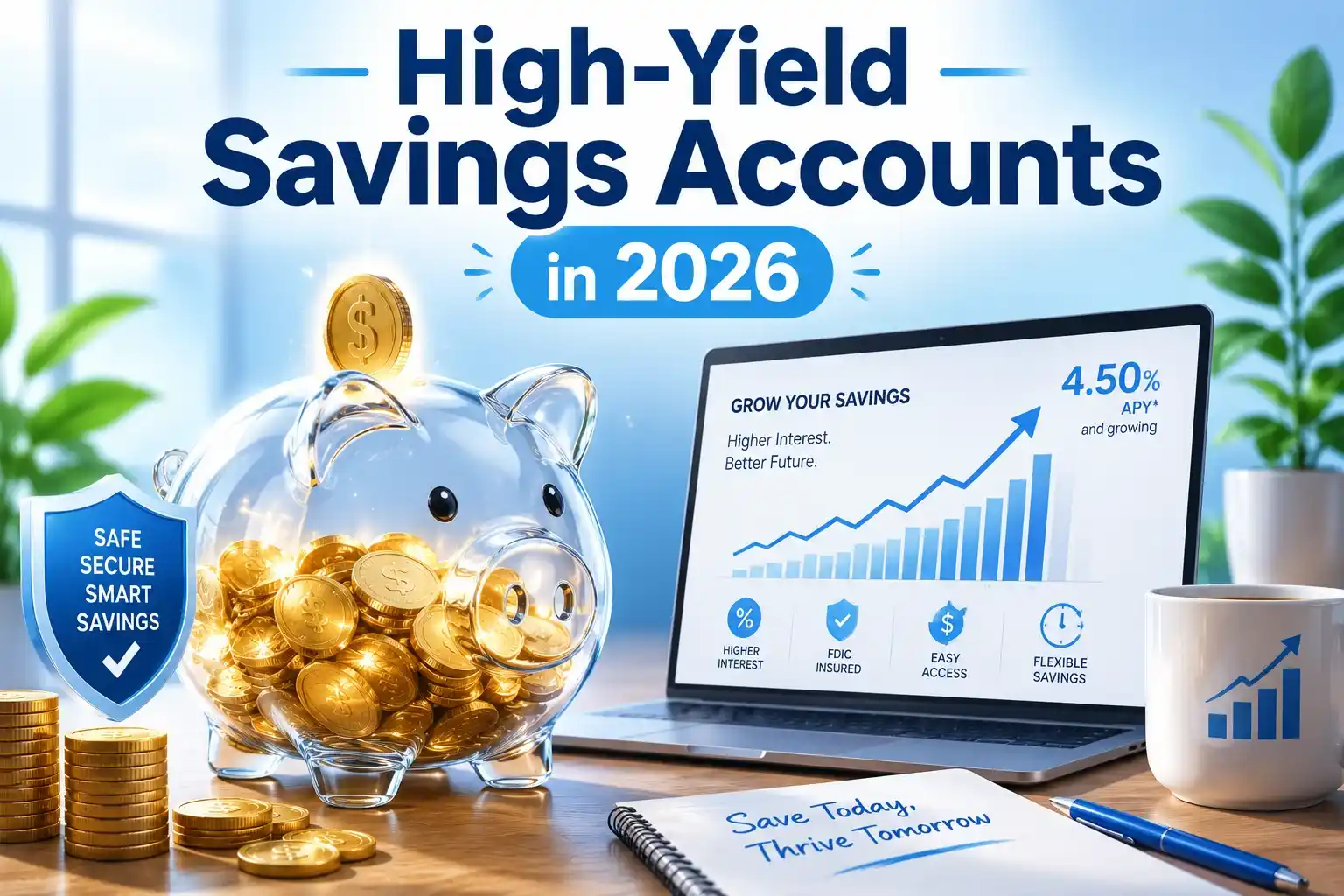
A high-yield savings account, commonly called an HYSA, is a type of savings account that offers a much higher annual percentage yield (APY) than a traditional savings account at a standard bank.
The national average interest rate on a regular savings account sits around 0.39% to 0.62% APY. High-yield savings accounts, particularly those offered by online banks, have been offering rates anywhere from 3% to over 4% APY in recent periods. That is a dramatic difference.
In simple words, if you have $5,000 saved, a regular savings account might earn you around $20 over a year. The same $5,000 in a high-yield savings account at a competitive rate could earn you over $200 in the same period. Same money, same safety, wildly different outcomes.
How Does a High-Yield Savings Account Work?
A high-yield savings account works exactly like a regular savings account in most ways. You deposit money, the bank holds it, and you earn interest on the balance. The key difference is that the interest rate is substantially higher.
Most high-yield savings accounts are offered by online banks. Because these banks do not operate physical branches, they have lower overhead costs, and they pass those savings on to customers in the form of higher interest rates. That is the simple reason why online banks tend to beat traditional banks on savings rates.
Your money in a high-yield savings account is just as safe as in a regular bank. Most accounts are FDIC insured up to $250,000 per depositor, per institution. That means if the bank fails, the federal government protects your deposits up to that limit.
You can still access your money when you need it. Unlike a certificate of deposit (CD), a high-yield savings account does not lock up your funds for a fixed period. You can transfer money out whenever you want, though some accounts have limits on the number of withdrawals per month.
Who Should Open a High-Yield Savings Account?
The short answer is: almost everyone who has savings. A high-yield savings account is particularly useful for the following situations.
Building an emergency fund. Financial experts consistently recommend keeping three to six months of essential expenses in an accessible savings account. A high-yield savings account is the ideal place for this money because it is safe, accessible, and actually earns meaningful interest while it sits there.
Saving toward a short-term goal. If you’re saving for a vacation, a down payment, home repairs, or any goal you plan to reach within one to five years, a high-yield savings account makes more sense than investing in the stock market, where there is risk of short-term loss.
Holding your regular savings. Even if you do not have a specific goal, any money you want to keep safe and liquid belongs in a high-yield savings account rather than a traditional one.
What to Look for in a High-Yield Savings Account
Not all high-yield savings accounts are created equal. Here are the key factors to compare before opening one.
APY (Annual Percentage Yield). This is the most important number. Look for the highest rate available, but also check whether it is a promotional introductory rate or the standard ongoing rate. Some accounts advertise high rates that drop significantly after a few months.
No monthly fees. Many of the best high-yield savings accounts charge no monthly maintenance fees. Avoid accounts that do, because fees can easily eat into the interest you earn.
No minimum balance requirement. Look for accounts that do not require you to maintain a specific balance to earn the advertised APY. Some accounts require $1,000, $5,000, or more to qualify for the top rate.
FDIC or NCUA insurance. Confirm the account is insured. FDIC covers banks, NCUA covers credit unions. This is non-negotiable.
Easy online access. Since high-yield savings accounts are almost always at online banks, a clean and reliable banking app and website matter. You should be able to check your balance, transfer money, and manage the account entirely from your phone or computer without frustration.
Withdrawal and transfer ease. Check how long transfers take to process. Some online banks take two to three business days to move money to an external account. If that timeline does not work for your needs, look for accounts with faster transfer options.
High-Yield Savings Accounts vs. Other Options
It helps to understand where a high-yield savings account fits in the broader landscape of places to keep your money.
HYSA vs. Regular Savings Account. A regular savings account is safe but earns almost nothing. A high-yield savings account earns meaningfully more while offering the same safety and access. There is almost no reason to choose a regular savings account for money you want to keep liquid.
HYSA vs. Certificate of Deposit (CD). A CD typically offers a fixed interest rate for a set period, often six months to five years. CDs sometimes offer higher rates than HYSAs, but your money is locked in. If you withdraw early, you pay a penalty. A HYSA gives you more flexibility while often earning competitive rates. For an emergency fund or money you might need access to, a HYSA wins over a CD.
HYSA vs. Money Market Account. Money market accounts are similar to HYSAs but sometimes come with check-writing privileges or a debit card. Rates are often comparable. The choice often comes down to which specific account offers better terms at the time you open it.
HYSA vs. Investing. This is not an either-or decision. Money you might need within the next one to three years should be in a HYSA. Money you won’t need for five or more years can be invested, where it has time to recover from market dips. Your emergency fund and short-term savings belong in a HYSA.
How to Open a High-Yield Savings Account
Opening a high-yield savings account is one of the easiest financial moves you can make. The process typically takes about 10 to 15 minutes online.
Here is how it generally works. First, compare accounts and choose one that fits your needs based on APY, fees, and minimum balance. Second, go to the bank’s website and click the option to open a new account. Third, provide personal information including your name, address, Social Security number, and date of birth for identity verification. Fourth, link your existing checking account by entering the routing and account numbers. Fifth, make an initial deposit, which can be as small as $1 at many online banks. That’s it.
Once your account is open, you can set up automatic transfers from your paycheck or checking account so your savings grow consistently without you having to think about it each month.
Common Mistakes to Avoid With a High-Yield Savings Account
A few things trip people up when they first open a high-yield savings account.
Not reading the fine print on introductory rates. Some banks advertise a high APY that only applies for the first three to six months. After that, the rate drops significantly. Always check whether the rate is ongoing or promotional.
Keeping too much money in one bank. FDIC insurance covers up to $250,000 per depositor per institution. If you have more than that saved, spread it across multiple banks to stay fully protected.
Treating it like a checking account. A high-yield savings account is for savings, not daily spending. Some accounts limit the number of monthly withdrawals. If you make too many, you may face fees or have your account converted to a checking account.
Forgetting to shop around as rates change. Interest rates on high-yield savings accounts change regularly. It is worth comparing rates once or twice a year to make sure your account is still competitive. Switching is easy and there is no penalty for moving your money.

Is a High-Yield Savings Account Worth It in 2026?
Without question, yes. Even as interest rates have moderated from their peaks, the gap between a regular savings account and a high-yield savings account remains enormous. If your money is going to sit in savings, it should work as hard as possible while it waits.
The Federal Reserve’s decisions on interest rates will continue to influence APYs throughout 2026. Rates may drift slightly lower as the year progresses, but even at a reduced rate, a high-yield savings account will still dramatically outperform a traditional bank savings account.
The effort required to open and use a high-yield savings account is minimal. The return on that effort, measured in actual dollars earned on your savings, is very real.
Final Thoughts
A high-yield savings account is one of the simplest, lowest-effort things you can do to improve your personal finances in 2026. You are not taking on any risk. You are not locking your money away. You are simply choosing a better home for the money you are already saving.
If you have not opened one yet, today is a good time to start comparing options. Your current savings account is probably paying you almost nothing. You deserve better than that.
Want to learn more about building your savings and managing your money smarter? Check out our guides on how to build an emergency fund, how to save money on a tight budget, and the best budgeting apps for 2026 at fiscible.com.