









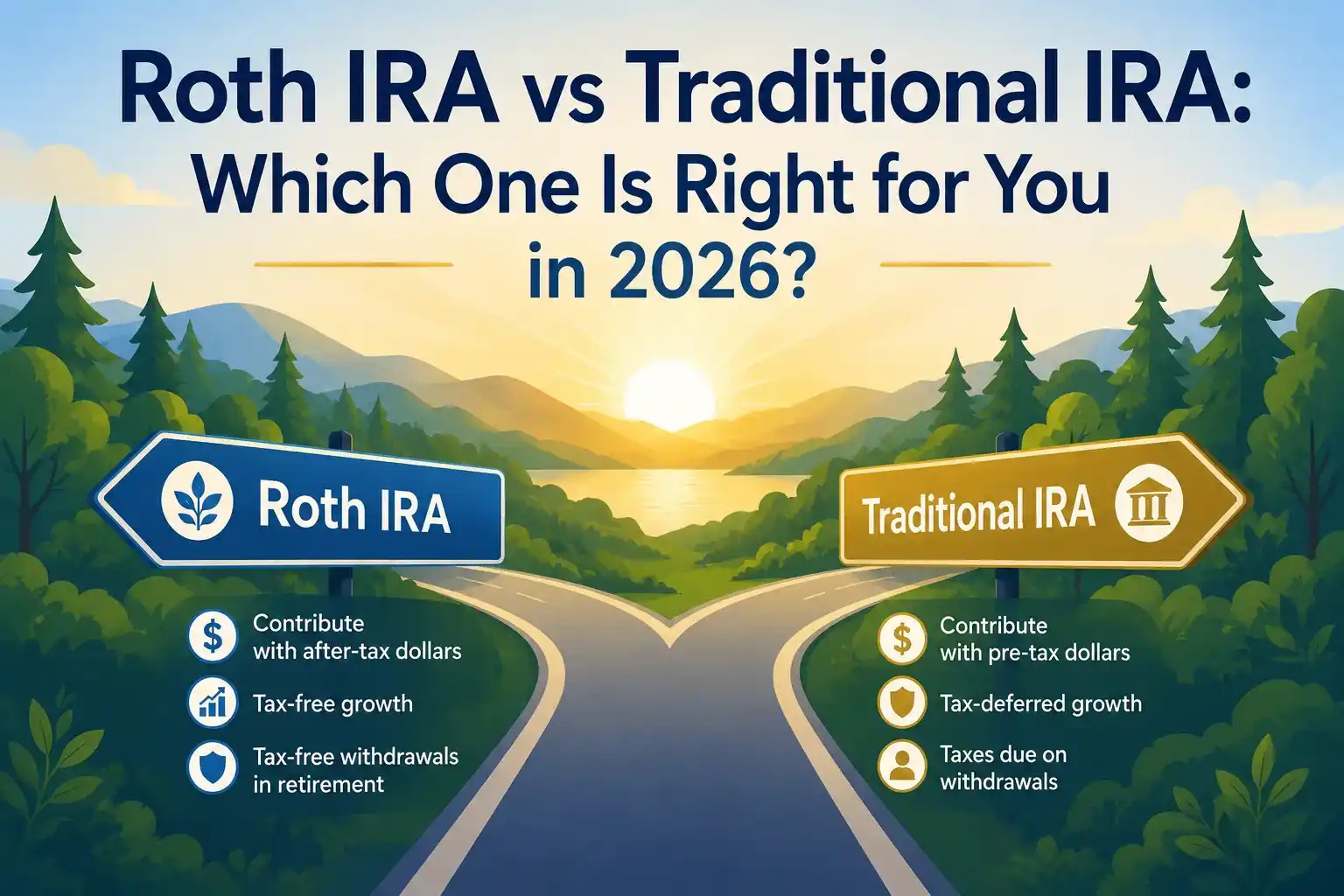
Roth IRA vs Traditional IRA: which one should you pick in 2026? This guide breaks down contribution limits, tax rules, withdrawal differences, and exactly who benefits most from each retirement account.
When people start thinking about retirement savings, one question comes up again and again: should I open a Roth IRA or a Traditional IRA? It sounds like a simple question, but the answer depends on your income, your tax situation, and how you expect your finances to look decades from now.
Both types of individual retirement accounts, commonly known as IRAs, are powerful tools for building long-term wealth. Both offer real tax advantages. But they work in very different ways, and choosing the wrong one for your situation can cost you in the long run.
This guide breaks down the Roth IRA vs Traditional IRA debate in plain language so you can make a smart, informed decision for your retirement savings in 2026.
What Is an IRA?
An IRA, or individual retirement account, is a tax-advantaged account that lets you invest money for retirement. Unlike a 401k, which is tied to your employer, an IRA is something you open on your own through a brokerage or financial institution.
There are two main types: the Roth IRA and the Traditional IRA. Both allow you to invest in stocks, bonds, index funds, ETFs, and other assets. The key difference between the two comes down to when you get your tax benefit.
Roth IRA vs Traditional IRA: The Core Difference
Think of it this way:
- With a Traditional IRA, you get the tax break now. Your contributions may be tax-deductible today, and your money grows tax-deferred. You pay taxes when you withdraw the money in retirement.
- With a Roth IRA, you pay taxes now and get the benefit later. Your contributions are made with after-tax dollars, so there is no immediate deduction. But your money grows tax-free, and qualified withdrawals in retirement are completely tax-free.
That one difference, pay now versus pay later, is what makes the Roth IRA vs Traditional IRA comparison so important to get right.
2026 IRA Contribution Limits
For 2026, the IRA contribution limits remain at:
- $7,000 per year if you are under age 50
- $8,000 per year if you are age 50 or older (the extra $1,000 is called the catch-up contribution)
This limit applies across all of your IRAs combined. So if you have both a Roth IRA vs Traditional IRA, you cannot put $7,000 into each. The $7,000 total is shared between them.
It is worth noting that these IRA contribution limits are the same regardless of which type of account you choose. The difference is not how much you can contribute but how that money is treated for tax purposes.

Roth IRA Income Limits in 2026
Here is something that catches a lot of people off guard: not everyone is eligible to contribute to a Roth IRA directly. The IRS has income limits for Roth IRA contributions.
For 2026, the Roth IRA income limits are:
- Single filers: Full contribution allowed if your MAGI is below $150,000. The ability to contribute phases out between $150,000 and $165,000. No direct Roth IRA contribution allowed above $165,000.
- Married filing jointly: Full contribution allowed below $236,000. Phase-out between $236,000 and $246,000.
(Note: Always verify the exact current IRS limits since these figures can be adjusted annually for inflation.)
If you earn too much to contribute to a Roth IRA directly, there is a strategy called the backdoor Roth IRA that allows higher earners to still take advantage of this retirement account. It involves making a non-deductible Traditional IRA contribution and then converting it to a Roth IRA.
Traditional IRAs do not have income limits for contributions, but the tax deductibility of your contributions may be limited depending on your income and whether you or your spouse have a workplace retirement plan.
Who Should Choose a Roth IRA?
A Roth IRA tends to make more sense if:
You are in a lower tax bracket now than you expect to be in retirement. The best time to pay taxes is when your rate is low. If you are early in your career and earning less, contributing to a Roth IRA means you pay a smaller tax bill today in exchange for completely tax-free income in retirement.
You are young and have decades for your money to grow. The power of a Roth IRA is the tax-free compounding. The longer your money sits and grows, the more dramatic the difference between paying taxes now versus paying them on a much larger amount later.
You want flexibility and no required minimum distributions. Unlike a Traditional IRA, a Roth IRA does not require you to take distributions at any age. Your money can stay invested and keep growing for as long as you want, and you can even pass a tax-free Roth IRA to your heirs.
You want to be able to access contributions without penalty. With a Roth IRA, you can withdraw your contributions (not the earnings) at any time, tax-free and penalty-free. This gives it a unique flexibility that the Traditional IRA does not offer.
Who Should Choose a Traditional IRA?
A Traditional IRA tends to make more sense if:
You are in a high tax bracket right now and expect to be in a lower one in retirement. If you are at peak earning years and making good money, deferring taxes makes real financial sense. The deduction you get today is worth more when your tax rate is high.
You need to lower your taxable income this year. If you are close to a threshold that triggers a higher tax rate or affects other deductions, a Traditional IRA contribution can reduce your taxable income right now, which has an immediate financial benefit.
You do not qualify for a Roth IRA due to income limits. If your income is above the Roth IRA income limits and the backdoor strategy feels complicated, a Traditional IRA is a straightforward way to keep investing for retirement with tax advantages.
You are older and closer to retirement. If retirement is just a few years away, there is less time for tax-free growth to work in favor of a Roth IRA. The immediate deduction of a Traditional IRA may deliver more value in a shorter window.
Roth IRA vs Traditional IRA: Withdrawal Rules
Understanding the withdrawal rules is critical before deciding between these two retirement accounts.
Traditional IRA Withdrawals:
- You can start taking withdrawals at age 59.5 without penalty
- Withdrawals are taxed as ordinary income
- You must start taking required minimum distributions (RMDs) at age 73
- Early withdrawals before 59.5 are subject to a 10% penalty plus income taxes (with some exceptions)
Roth IRA Withdrawals:
- You can withdraw your contributions at any age without taxes or penalties
- Earnings can be withdrawn tax-free and penalty-free after age 59.5, provided the account has been open for at least five years (the five-year rule)
- No required minimum distributions during your lifetime
- Early withdrawal of earnings before age 59.5 may trigger taxes and a 10% penalty
The absence of required minimum distributions is one of the most underrated advantages of the Roth IRA. It gives you much more control over your retirement income and tax planning in your later years.
The Power of Tax-Free Growth: A Real-World Example
To really understand why the Roth IRA vs Traditional IRA decision matters, consider this example.
Imagine two people, both 30 years old, both contributing $6,500 per year. One puts it in a Roth IRA, the other in a Traditional IRA. Both earn a 7% average annual return. By age 65, both accounts have grown to around $920,000.
The person with the Traditional IRA will pay income taxes on every dollar they withdraw. If they are in the 22% tax bracket in retirement, a $920,000 balance effectively becomes closer to $717,000 in after-tax wealth.
The person with the Roth IRA pays no taxes on those withdrawals. Their $920,000 is $920,000.
That is not a small difference. That is over $200,000. And this example uses a modest return and a moderate tax rate. Real-world gaps can be even larger depending on your situation.
Can You Have Both a Roth IRA and a Traditional IRA?
Yes, you can have both types of retirement accounts at the same time. Many people do. Just remember that the combined contribution limit for 2026 is $7,000 (or $8,000 if you are 50 or older). You can split contributions between the two accounts however you like, but you cannot exceed the total limit.
Some people choose to split contributions between a Roth IRA and a Traditional IRA as a form of tax diversification, hedging against future uncertainty about tax rates. This is a completely valid strategy, especially for people who are not sure whether their tax situation in retirement will be higher or lower than it is today.
Roth IRA vs Traditional IRA: Quick Comparison
| Feature | Roth IRA | Traditional IRA |
|---|---|---|
| Tax on contributions | After-tax (no deduction) | Pre-tax (may be deductible) |
| Tax on withdrawals | Tax-free | Taxed as income |
| Income limits | Yes | No (but deductibility may be limited) |
| Required minimum distributions | None | Starts at age 73 |
| Early withdrawal of contributions | Penalty-free | Taxed + 10% penalty |
| Best for | Lower tax bracket now | Higher tax bracket now |
How to Open an IRA in 2026
Opening an IRA is easier than most people expect. You can open a Roth IRA or Traditional IRA directly through:
- Fidelity (no minimums, strong index fund options)
- Vanguard (known for low-cost index funds)
- Charles Schwab (user-friendly, no minimums)
- Betterment or Wealthfront (robo-advisors that automate investing for you)
Once the account is open, you contribute money and then invest it. Many people invest in low-cost index funds or target-date retirement funds, which automatically adjust their asset mix as you get closer to retirement.
One common mistake is opening the IRA and then leaving the money sitting in cash without investing it. Opening the account is just step one. Investing the money is what makes it grow.
Final Thoughts: Roth IRA or Traditional IRA?
Here is the simplest way to think about the Roth IRA vs Traditional IRA decision:
If you expect to be in a higher tax bracket in retirement than you are now, go with the Roth IRA beween Roth IRA vs Traditional IRA. Pay the smaller tax bill today and enjoy tax-free income later.
If you expect to be in a lower tax bracket in retirement, or if you need the immediate tax deduction right now, the Traditional IRA is likely the better fit.
If you genuinely are not sure, contributing to a Roth IRA is usually the safer default, especially if you are under 40. The flexibility, the tax-free growth over decades, and the lack of required minimum distributions are powerful advantages that tend to pay off over long time horizons.
Whatever you choose, the most important thing is to start contributing to a retirement account today. The longer your money has to grow, the more it works for you. Both the Roth IRA and the Traditional IRA are excellent tools. Picking either one and contributing consistently is far better than spending years trying to decide between them.
Ready to take the next step? Read our guide on How to Start Investing Money in 2026 and check out our Passive Income Ideas for 2026 to keep building your financial future.