





Looking for realistic passive income ideas in 2026?

Passive income is one of those phrases that gets thrown around constantly, usually attached to unrealistic promises about making thousands a week while doing nothing.
The truth is a little less flashy but a lot more useful.
Real passive income does require work upfront. Most streams require either time, money, or skills to get going. But once the system is in place, they continue generating income with far less ongoing effort than a traditional job or side hustle. And in 2026, with the cost of living still higher than most people are comfortable with, having even one extra income stream can take a lot of pressure off your monthly budget.
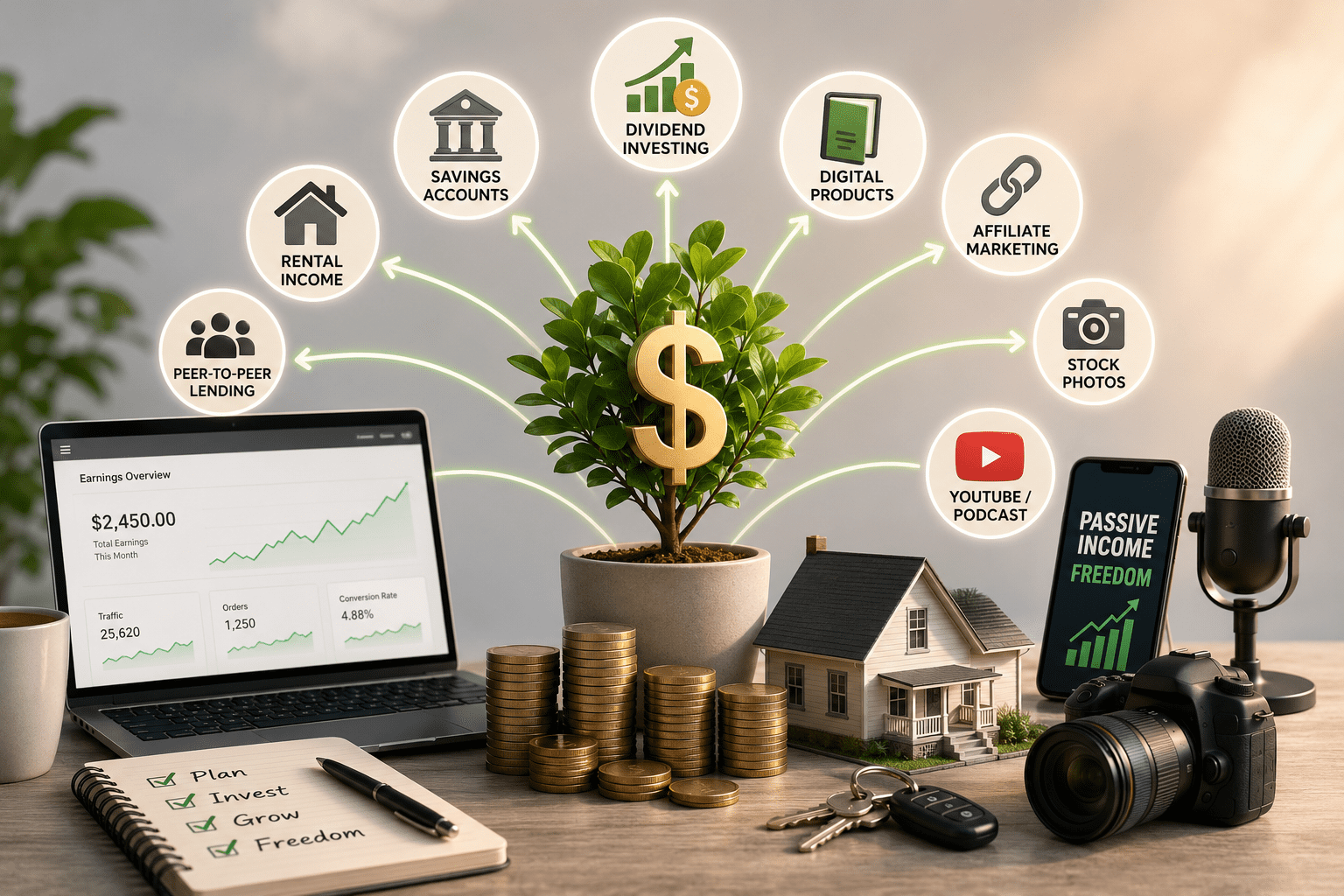
This guide covers 10 legitimate passive income ideas that are realistic for everyday people, whether you have a few hundred dollars to invest or just some time and a skill to share.
Why Passive Income Matters More Than Ever in 2026
Inflation has eased from its peaks, but prices on groceries, housing, and everyday expenses remain elevated compared to just a few years ago.
At the same time, the gig economy has matured to the point where building scalable income streams is more accessible than it has ever been.
More importantly, relying on a single income source is increasingly risky. Jobs can disappear, hours can get cut, and unexpected expenses never seem to arrive at a convenient time.
Passive income is not about getting rich quickly. It is about building a financial cushion that makes life more stable and less stressful.
Even an extra $300 to $500 per month in passive income can cover a car payment, a utility bill, or a portion of rent. That is real money with real impact.
What Passive Income Actually Looks Like (Setting Realistic Expectations)
Before we get into specifics, here is an honest truth: most passive income streams start slow. You might put in 10 to 20 hours of work upfront and see only $20 in the first month. That can feel discouraging.
The difference between people who build meaningful passive income and those who give up is persistence through the early stages. The income tends to compound over time. A blog with 50 articles earns more than one with 5. A rental property in year three earns more predictably than in year one.
Set realistic expectations, start with one stream, and give it genuine time before judging whether it is working.
Online platforms have made it easier than ever to start building digital income streams from home.
1. High Yield Savings Accounts and Money Market Accounts
This is the easiest starting point. If you have money sitting in a traditional bank account earning 0.01% interest, you are leaving money on the table.
High-yield savings accounts currently offer rates in the 4% to 5% APY range at online banks. That means $10,000 in savings earns roughly $400 to $500 per year with zero effort on your part after the initial deposit.
It will not make you rich, but it is the most passive thing on this list and a great foundation while you build other streams.
What you need to start: Some savings to deposit. That’s it.
2. Dividend-Paying Stocks and Index Funds
When you own shares in a company that pays dividends, you receive a portion of the company’s profits just for holding the stock. Reinvest those dividends over time and you benefit from compounding growth.
Index funds that track the S&P 500 or other broad markets also tend to generate solid long-term returns. You are not picking individual stocks, which reduces risk and requires far less knowledge or attention.
The key word here is long-term. This is not a get-rich-fast strategy. But it is one of the most powerful wealth-building tools available to ordinary people who start early and stay consistent.
What you need to start: A brokerage account and as little as $50 to begin with fractional shares.
3. Create and Sell a Digital Product
Digital products are one of the most genuinely passive income opportunities available in 2026. You create something once, and it can sell indefinitely.
Digital products include:
• Ebooks or guides on a topic you know well
• Templates (resume templates, budget spreadsheets, Canva social media templates)
• Courses or video tutorials
• Printable planners or worksheets
• Presets for photo editing
The upfront investment is mostly your time. Once the product exists, you can sell it on platforms like Etsy, Gumroad, Teachable, or your own website. You handle fulfillment automatically. No inventory, no shipping, no customer service beyond the occasional email.
The income from digital products can range from a few dollars to several thousand per month depending on the niche, your marketing, and how much you reinvest in growing your audience.
What you need to start: A skill, some time, and a platform to sell on.
4. Affiliate Marketing
Affiliate marketing means recommending products or services and earning a commission when someone makes a purchase through your link. It works through blogs, YouTube channels, podcasts, email newsletters, or social media.
For example, if you write a blog about personal finance (like this one), you might include affiliate links to budgeting tools, financial apps, or recommended books. When a reader clicks and buys, you earn a percentage.
The passive part comes once the content is created. A blog post written today can earn affiliate commissions for years. The challenge is building an audience large enough to generate meaningful clicks, which takes consistent effort over time.
What you need to start: A content platform (blog, YouTube channel, newsletter), a niche, and some affiliate programs to join. Many are free to join, including Amazon Associates, ShareASale, and various financial service programs.
Content creation is one of the most scalable passive income paths when done consistently over time.
5. Rent Out What You Own
This one is surprisingly underused. If you own assets that sit idle, you can rent them out for income. Some examples:
• Rent a room or property: If you have extra space in your home, renting a room can bring in hundreds of dollars per month. Platforms like Airbnb make this relatively straightforward.
• Rent your car: If your car sits parked for long stretches, platforms like Turo let you rent it to vetted drivers.
• Rent equipment or tools: Storage units, camera gear, musical instruments, and recreational equipment can all be rented through various platforms.
• Rent a parking spot: If you live in a city and have a parking space you rarely use, this alone can earn $100 to $300 per month depending on location.
These income streams do require some management, but they are largely passive once the listing is set up and a good process is in place.
What you need to start: An asset you already own and a listing on the right platform.
6. Write a Book or Self-Publish Content
The barrier to publishing a book has essentially disappeared. Through Amazon Kindle Direct Publishing (KDP), you can write and publish an ebook or print-on-demand book without a traditional publisher.
Every time someone buys your book, you earn a royalty. Nonfiction books that solve specific problems tend to sell consistently year after year.
This requires real work upfront. Writing a book is not quick. But a well-written, well-researched book on a topic people search for can generate royalties for years with no ongoing work beyond occasional marketing.
What you need to start: Something valuable to say, time to write it, and an Amazon KDP account.
7. Build a Niche Blog or Content Website
This one is a longer game but can be highly rewarding. A blog that consistently publishes useful, SEO-optimized content around a specific topic can earn through advertising (Google AdSense or similar), affiliate marketing, sponsored posts, and digital product sales.
The key is choosing a niche you genuinely understand and can write about in depth. Finance, health, travel, parenting, and food are all proven areas, but even smaller niches can be profitable if the content is excellent.
Most blogs take 12 to 24 months to gain meaningful traffic. But once a site has a library of well- ranking articles, the traffic (and income) tends to be consistent and grows over time.
What you need to start: A domain, hosting (roughly $5 to $10 per month), and consistent publishing.
8. Peer-to-Peer Lending
Peer-to-peer lending platforms connect individual investors with borrowers who need personal loans. As the lender, you earn interest on the money you lend. Returns typically range from 5% to 10% depending on the risk level of the borrowers you choose.
This does carry more risk than a savings account since there is always the possibility a borrower defaults. Spreading your money across many small loans reduces this risk.
What you need to start: An account on a P2P platform and some capital to lend. Start small until you understand how the platform works.
9. License Your Photography or Design Work
If you enjoy photography or graphic design, platforms like Shutterstock, Adobe Stock, and Getty Images let you upload your work and earn royalties whenever someone licenses it.
This income stream is genuinely passive once the work is uploaded. One good image can earn a small amount hundreds of times over. The challenge is that you need a fairly large portfolio to generate significant income, but it stacks over time.
What you need to start: A camera (even a quality smartphone), an eye for good shots, and a free account on a stock photo platform.
10. Build a YouTube Channel or Podcast
These are longer-term plays, but the passive income potential is real. YouTube videos continue earning ad revenue for years after they are posted. Podcasts can generate sponsorship income and affiliate earnings from episodes that aired months or years ago.
The challenge is that building an audience takes consistent effort and time. But people who pick a focused niche and commit to quality output for 12 to 18 months often find themselves earning meaningfully from content they created in the past.
What you need to start: A niche, a microphone (for podcasting), a camera (for YouTube), and a commitment to consistency.
How to Choose the Right Passive Income Stream for You
With so many options, the biggest mistake is trying to do everything at once. Pick one stream that matches your situation:
• No money to invest, but have time? Start with a blog, digital product, or YouTube channel.
• Have some savings to put to work? High-yield savings, dividend investing, or P2P lending.
• Have skills or expertise? Create an online course or ebook.
• Already own assets? Rent them out through the right platforms.
Build one stream until it is running reasonably well before starting another. Scattered effort produces scattered results.
Mistakes to Avoid When Building Passive Income
Chasing “easy” money. If something promises massive returns with zero effort and no risk, it is not legitimate. Real passive income requires real work, especially upfront.
Giving up too early. Most passive income streams look like failures in the first few months. The people who succeed are the ones who kept going.
Neglecting taxes. Passive income is taxable. Keep records of what you earn and set aside a portion for taxes. Consulting a tax professional once your income grows is worth the investment.
Not reinvesting earnings. The compounding effect of reinvesting your early passive income into the same stream (or a new one) accelerates your progress significantly.
Putting It All Together
Passive income is not magic. But it is real, and it is available to more people than ever in 2026. The tools, platforms, and resources to build multiple income streams are genuinely accessible without a large upfront investment.
The goal does not have to be quitting your job. For most people, an extra $500 to $1,000 per month from passive income is genuinely life-changing. It means less stress about unexpected bills, faster debt payoff, earlier retirement contributions, and more choices in how you live.
Start with one idea. Give it real effort. Stay consistent. That is the whole secret
Looking to understand your full financial picture? Use the Take-Home Pay Calculator at Fiscible to know exactly what you’re bringing home each month, so you can plan how much to put toward passive income building.
Related reads:
• How to Build an Emergency Fund in 2026
• Smart Money Tips: Practical Strategies That Actually Work in 2026
• How to Be Smart with Money in Your 20s
Looking for realistic passive income ideas in 2026? This guide covers 10 proven ways to earn extra money with less ongoing effort, including options for beginners with little or no startup cash.
Building passive income takes upfront work, but the payoff keeps coming long after you stop actively working.
Passive income is one of those phrases that gets thrown around constantly, usually attached to unrealistic promises about making thousands a week while doing nothing. The truth is a little less flashy but a lot more useful.
Real passive income does require work upfront. Most streams require either time, money, or skills to get going. But once the system is in place, they continue generating income with far less ongoing effort than a traditional job or side hustle. And in 2026, with the cost of living still higher than most people are comfortable with, having even one extra income stream can take a lot of pressure off your monthly budget.
This guide covers 10 legitimate passive income ideas that are realistic for everyday people, whether you have a few hundred dollars to invest or just some time and a skill to share.
Why Passive Income Matters More Than Ever in 2026
Inflation has eased from its peaks, but prices on groceries, housing, and everyday expenses remain elevated compared to just a few years ago. At the same time, the gig economy has matured to the point where building scalable income streams is more accessible than it has ever been.
More importantly, relying on a single income source is increasingly risky. Jobs can disappear, hours can get cut, and unexpected expenses never seem to arrive at a convenient time. Passive income is not about getting rich quickly. It is about building a financial cushion that makes life more stable and less stressful.
Even an extra $300 to $500 per month in passive income can cover a car payment, a utility bill, or a portion of rent. That is real money with real impact.
What Passive Income Actually Looks Like (Setting Realistic Expectations)
Before we get into specifics, here is an honest truth: most passive income streams start slow. You might put in 10 to 20 hours of work upfront and see only $20 in the first month. That can feel discouraging.
The difference between people who build meaningful passive income and those who give up is persistence through the early stages. The income tends to compound over time. A blog with 50 articles earns more than one with 5. A rental property in year three earns more predictably than in year one.
Set realistic expectations, start with one stream, and give it genuine time before judging whether it is working.
Online platforms have made it easier than ever to start building digital income streams from home.
1. High Yield Savings Accounts and Money Market Accounts
This is the easiest starting point. If you have money sitting in a traditional bank account earning 0.01% interest, you are leaving money on the table.
High-yield savings accounts currently offer rates in the 4% to 5% APY range at online banks. That means $10,000 in savings earns roughly $400 to $500 per year with zero effort on your part after the initial deposit.
It will not make you rich, but it is the most passive thing on this list and a great foundation while you build other streams.
What you need to start: Some savings to deposit. That’s it.
2. Dividend-Paying Stocks and Index Funds
When you own shares in a company that pays dividends, you receive a portion of the company’s profits just for holding the stock. Reinvest those dividends over time and you benefit from compounding growth.
Index funds that track the S&P 500 or other broad markets also tend to generate solid long-term returns. You are not picking individual stocks, which reduces risk and requires far less knowledge or attention.
The key word here is long-term. This is not a get-rich-fast strategy. But it is one of the most powerful wealth-building tools available to ordinary people who start early and stay consistent.
What you need to start: A brokerage account and as little as $50 to begin with fractional shares.
3. Create and Sell a Digital Product
Digital products are one of the most genuinely passive income opportunities available in 2026. You create something once, and it can sell indefinitely.
Digital products include:
• Ebooks or guides on a topic you know well
• Templates (resume templates, budget spreadsheets, Canva social media templates)
• Courses or video tutorials
• Printable planners or worksheets
• Presets for photo editing
The upfront investment is mostly your time. Once the product exists, you can sell it on platforms like Etsy, Gumroad, Teachable, or your own website. You handle fulfillment automatically. No inventory, no shipping, no customer service beyond the occasional email.
The income from digital products can range from a few dollars to several thousand per month depending on the niche, your marketing, and how much you reinvest in growing your audience.
What you need to start: A skill, some time, and a platform to sell on.
4. Affiliate Marketing
Affiliate marketing means recommending products or services and earning a commission when someone makes a purchase through your link. It works through blogs, YouTube channels, podcasts, email newsletters, or social media.
For example, if you write a blog about personal finance (like this one), you might include affiliate links to budgeting tools, financial apps, or recommended books. When a reader clicks and buys, you earn a percentage.
The passive part comes once the content is created. A blog post written today can earn affiliate commissions for years. The challenge is building an audience large enough to generate meaningful clicks, which takes consistent effort over time.
What you need to start: A content platform (blog, YouTube channel, newsletter), a niche, and some affiliate programs to join. Many are free to join, including Amazon Associates, ShareASale, and various financial service programs.
Content creation is one of the most scalable passive income paths when done consistently over time.
5. Rent Out What You Own
This one is surprisingly underused. If you own assets that sit idle, you can rent them out for income. Some examples:
• Rent a room or property: If you have extra space in your home, renting a room can bring in hundreds of dollars per month. Platforms like Airbnb make this relatively straightforward.
• Rent your car: If your car sits parked for long stretches, platforms like Turo let you rent it to vetted drivers.
• Rent equipment or tools: Storage units, camera gear, musical instruments, and recreational equipment can all be rented through various platforms.
• Rent a parking spot: If you live in a city and have a parking space you rarely use, this alone can earn $100 to $300 per month depending on location.
These income streams do require some management, but they are largely passive once the listing is set up and a good process is in place.
What you need to start: An asset you already own and a listing on the right platform.
6. Write a Book or Self-Publish Content
The barrier to publishing a book has essentially disappeared. Through Amazon Kindle Direct Publishing (KDP), you can write and publish an ebook or print-on-demand book without a traditional publisher.
Every time someone buys your book, you earn a royalty. Nonfiction books that solve specific problems tend to sell consistently year after year.
This requires real work upfront. Writing a book is not quick. But a well-written, well-researched book on a topic people search for can generate royalties for years with no ongoing work beyond occasional marketing.
What you need to start: Something valuable to say, time to write it, and an Amazon KDP account.
7. Build a Niche Blog or Content Website
This one is a longer game but can be highly rewarding. A blog that consistently publishes useful, SEO-optimized content around a specific topic can earn through advertising (Google AdSense or similar), affiliate marketing, sponsored posts, and digital product sales.
The key is choosing a niche you genuinely understand and can write about in depth. Finance, health, travel, parenting, and food are all proven areas, but even smaller niches can be profitable if the content is excellent.
Most blogs take 12 to 24 months to gain meaningful traffic. But once a site has a library of well- ranking articles, the traffic (and income) tends to be consistent and grows over time.
What you need to start: A domain, hosting (roughly $5 to $10 per month), and consistent publishing.
8. Peer-to-Peer Lending
Peer-to-peer lending platforms connect individual investors with borrowers who need personal loans. As the lender, you earn interest on the money you lend. Returns typically range from 5% to 10% depending on the risk level of the borrowers you choose.
This does carry more risk than a savings account since there is always the possibility a borrower defaults. Spreading your money across many small loans reduces this risk.
What you need to start: An account on a P2P platform and some capital to lend. Start small until you understand how the platform works.
9. License Your Photography or Design Work
If you enjoy photography or graphic design, platforms like Shutterstock, Adobe Stock, and Getty Images let you upload your work and earn royalties whenever someone licenses it.
This income stream is genuinely passive once the work is uploaded. One good image can earn a small amount hundreds of times over. The challenge is that you need a fairly large portfolio to generate significant income, but it stacks over time.
What you need to start: A camera (even a quality smartphone), an eye for good shots, and a free account on a stock photo platform.
10. Build a YouTube Channel or Podcast
These are longer-term plays, but the passive income potential is real. YouTube videos continue earning ad revenue for years after they are posted. Podcasts can generate sponsorship income and affiliate earnings from episodes that aired months or years ago.
The challenge is that building an audience takes consistent effort and time. But people who pick a focused niche and commit to quality output for 12 to 18 months often find themselves earning meaningfully from content they created in the past.
What you need to start: A niche, a microphone (for podcasting), a camera (for YouTube), and a commitment to consistency.
How to Choose the Right Passive Income Stream for You
With so many options, the biggest mistake is trying to do everything at once. Pick one stream that matches your situation:
• No money to invest, but have time? Start with a blog, digital product, or YouTube channel.
• Have some savings to put to work? High-yield savings, dividend investing, or P2P lending.
• Have skills or expertise? Create an online course or ebook.
• Already own assets? Rent them out through the right platforms.
Build one stream until it is running reasonably well before starting another. Scattered effort produces scattered results.
Mistakes to Avoid When Building Passive Income
Chasing “easy” money. If something promises massive returns with zero effort and no risk, it is not legitimate. Real passive income requires real work, especially upfront.
Giving up too early. Most passive income streams look like failures in the first few months. The people who succeed are the ones who kept going.
Neglecting taxes. Passive income is taxable. Keep records of what you earn and set aside a portion for taxes. Consulting a tax professional once your income grows is worth the investment.
Not reinvesting earnings. The compounding effect of reinvesting your early passive income into the same stream (or a new one) accelerates your progress significantly.
Putting It All Together
Passive income is not magic. But it is real, and it is available to more people than ever in 2026. The tools, platforms, and resources to build multiple income streams are genuinely accessible without a large upfront investment.
The goal does not have to be quitting your job. For most people, an extra $500 to $1,000 per month from passive income is genuinely life-changing. It means less stress about unexpected bills, faster debt payoff, earlier retirement contributions, and more choices in how you live.
Start with one idea. Give it real effort. Stay consistent. That is the whole secret
Looking to understand your full financial picture? Use the Take-Home Pay Calculator at Fiscible to know exactly what you’re bringing home each month, so you can plan how much to put toward passive income building.






One thought on “PASSIVE INCOME IDEAS FOR 2026: A STRONG MONEY MAKING GUIDE”